The 3 Key Design Features of Bamboo Split Beams
By | July 15, 2025 | Construction -

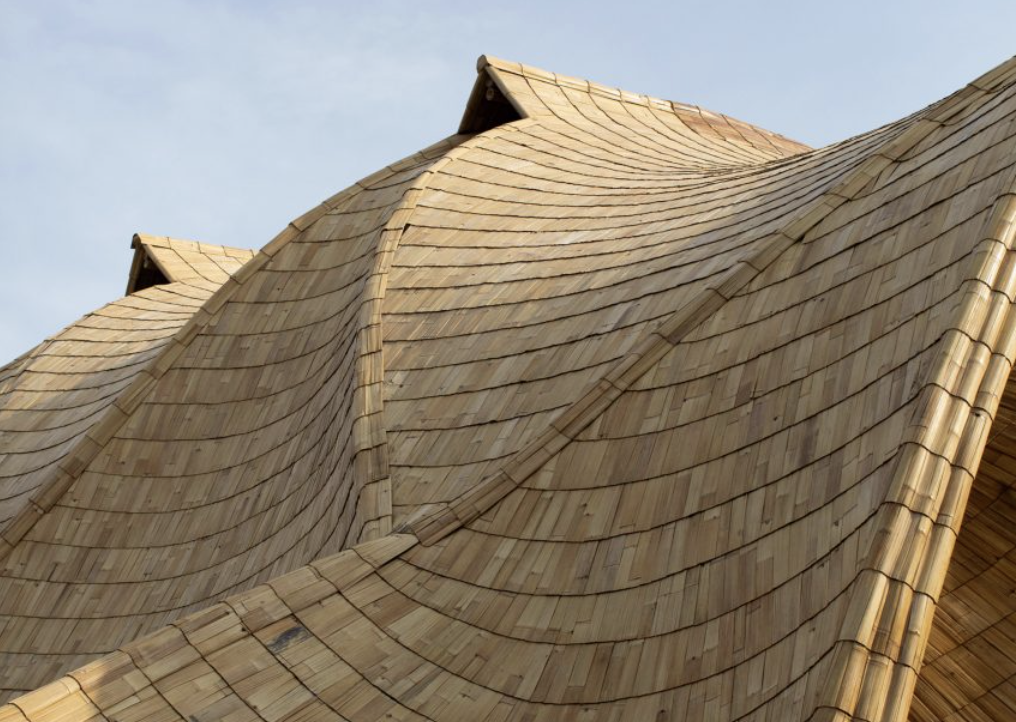
For several years, design and construction firms in Bali, such as IBUKU and Bamboo Pure focused on working with bamboo in its round-pole form for construction. However, in recent years firms have been experimenting with bamboo split beams for construction
Bamboo split beams feature bamboo that has been longitudinally split into strips. These splits are then held together and layered to form structural members, that are being increasingly used for contemporary bamboo construction projects. This article will focus on the three basic design features of bamboo split beams that Bamboo Pure and Bamboo U have been experimenting with. These structural members are crafted to be visually appealing and offer more strength-bearing capacity than traditional round pole construction.
Related: What Properties Make Bamboo an Excellent Material for Construction?
Unlike round-pole construction, bamboo split beams are pre-fabricated to match specific visual and load-bearing requirements. This poses an advantage for designers and engineers in the building process. For example, craftsmen can produce the exact curves specified by designers. Meanwhile, engineers can determine the required dimensions of specific structural elements. This makes them extremely versatile and streamlines the overall construction process.
For round-pole bamboo construction, the process features more on-site activity rather than pre-fabrication. Designers and engineers will specify the bamboo species, properties, and dimensions, based on aesthetic and structural requirements for the building. Then, the bamboo poles that best suit these attributes are selected from the available material on-site. Since bamboo is a natural material and can vary greatly in its properties, we often include a 10-20% material contingency during the procurement process. Therefore, compared to the use of bamboo round poles, the use of split beams can be a more efficient method of building with bamboo.
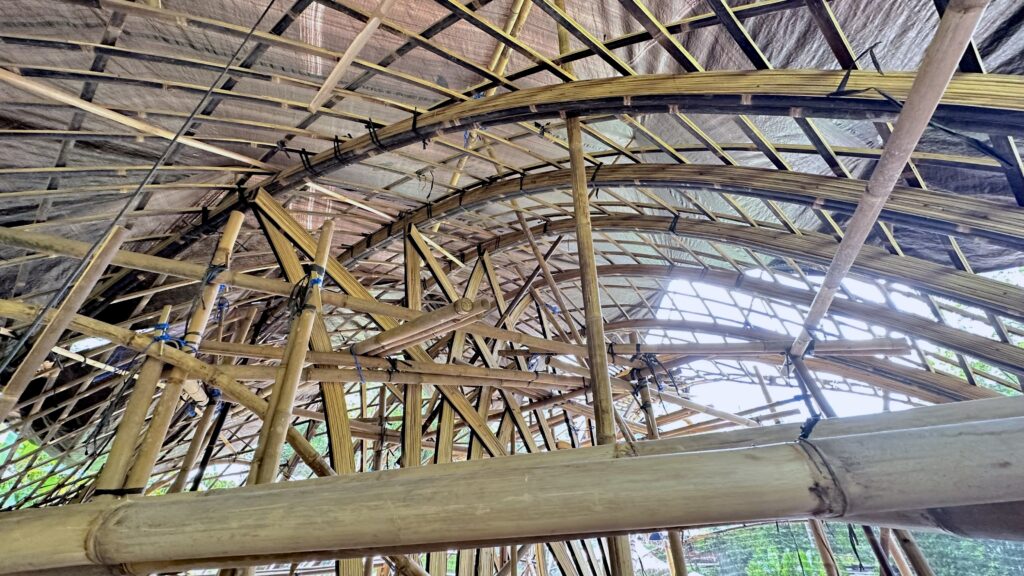
At the Bamboo Pure Factory and here at Bamboo U, we have been experimenting and testing split beams made from the locally-available Dendrocalamus asper species. This is the most common species we use for structural components in round-pole construction. Now, we are experimenting with how this works when processed into beams.
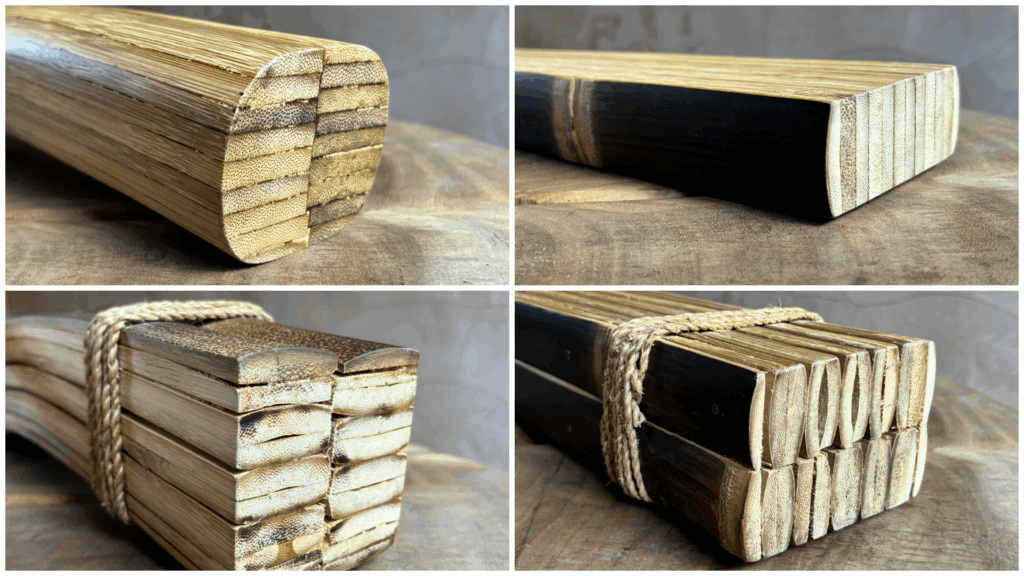
We have been examining three factors to explore various visual properties and structural capabilities of the split beams. We have trialed various methods of fastening splits, variations in the amount of bamboo skin (epidermis) the splits retain, and testing the impact of the number of beam modules in a structural element.
Fastening Methods
First, let’s explore fastening methods. These refer to how the components of the split beam are held together and are often done using bamboo pins, glues, or a combination of both.
Bamboo pins, also referred to as pegs or dowels, are inserted approximately perpendicular to a stack of splits. This fastens all the splits in place and can be supplemented with wire ties for a firmer hold. Pins are typically used when the bamboo splits retain at least some of the bamboo epidermis (skin). Due to its high-silica content, the skin is quite slippery, which makes it less effective with bound with adhesives.
Adhesives or glues are another useful method for fastening. Adhesives can include substances such as epoxy resin, PVA, and modified latex and require at least a partial removal of the bamboo skin. Meanwhile, fully-planed splits can be glued together to create forms of laminated bamboo lumber. These laminated bamboo split beams look and perform similarly to other forms of engineered timber.

The Bamboo’s Skin
The second variable when it comes to designing bamboo split beams is working with different levels of the bamboo’s skin.
Unlike its effect on bamboo poles, the bamboo’s skin is not one of the primary indicators of strength in split beams. Instead, retaining the bamboo’s skin is often for aesthetic purposes, as it provides the element with a more rustic look. In fact, fully-planed, laminated bamboo beams, which are fastened together with an adhesive such as epoxy, are much stronger than split beams that maintain the epidermis. This is because the beam acts as a single solid unit, rather than a sum of multiple parts that may expand and contract due to changes in humidity or even a shift in position over time.
Testing on bamboo split beams done at the Bamboo Pure Factory has yielded some fascinating results. For example, split beams that were semi-planed, pinned, and glued could bear up to three times the load of full-skin beams fastened together with pins alone. Meanwhile, fully-laminated beams (held together with epoxy resin only) were twice as strong as beams that were semi-planed and fastened with pins and adhesive.
Beam Modules
Bamboo split beams are composed of modules. By increasing the depth or number of modules in a structural element, one can significantly boost its load-bearing capacity. Each module consists of a stack of vertically-arranged splits. One stack of splits creates a single beam. Joining two of these beams side by side creates a double beam, three splits create a triple beam, and so on.
Modules can also be manipulated by increasing their depth. Each split that is added to a split beam member increases the beam’s load-bearing capacity by a factor of one. In this way, two splits stacked to create a split beam can provide almost double the strength of a single split, while three splits nearly triple the beam’s capacity.
Working with an engineer is crucial to understand the load paths and stress distribution on the building’s structural elements. They will be able to provide guidance on dimensions of a structural element to handle project- or even site-specific loads, such as wind or seismic forces. While bamboo round-pole construction is limited by the dimensions of the poles being used, split beams are more efficient due to their ability to be pre-fabricated based on the structural and aesthetic requirements of a space.

Overall, bamboo split beams can be manipulated using the three main variables: Fastening methods, retention of the epidermis, and dimensions of modules. Due to the flexibility that bamboo split beams provide in prefabrication, they are becoming increasingly common in bamboo construction. The increasing research and development of bamboo in these forms, particularly laminated bamboo lumber, opens up the potential for the material to be used structurally across the world beyond its round-pole form, even in regions where bamboo construction is currently not yet part of the building codes.

Images of built projects courtesy of IBUKU and Bamboo Pure
Are you interested in learning the skills of building with bamboo? Join us for one of our in-person or online workshops HERE!
Learn to design and build with bamboo in Bali.
Join the 11-Day Bamboo Build and Design Course: hands-on building alongside experts, architects and makers from around the world.
Explore the 11-Day CoursePrefer to start online?







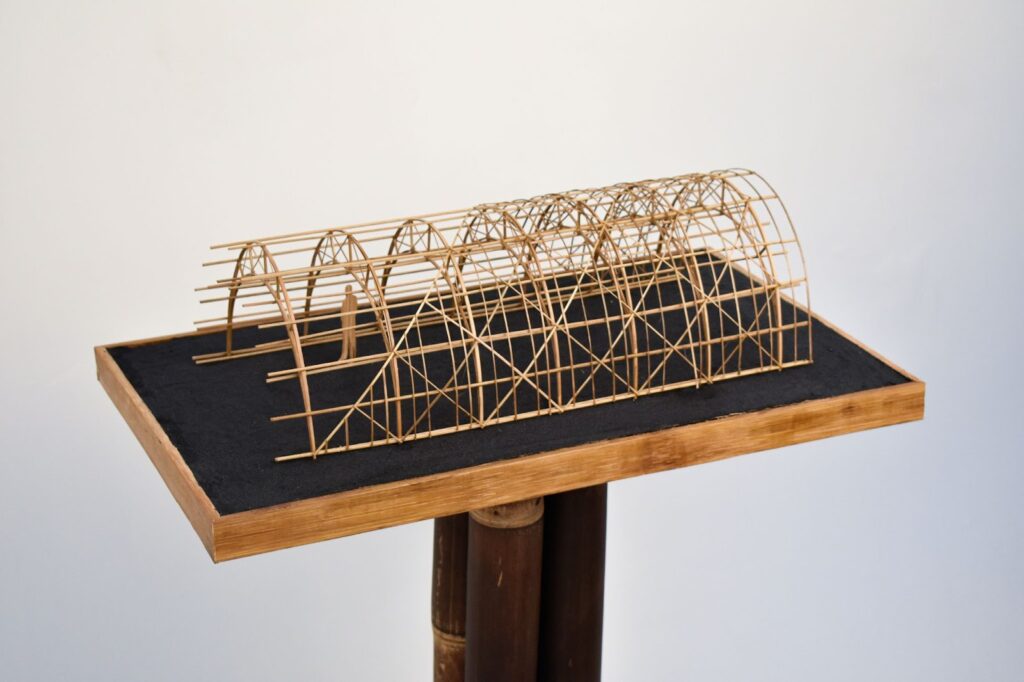


The 11-Day Build & Design Course
In collaboration with IBUKU
Immersed in the most beautiful and innovative bamboo environment. Meet the pioneers, the visionaries, the designers and builders who took this under-utilized material and transformed it into the most desired natural building material for bamboo structure design.

The Intro to Bamboo Engineering Online Course
Designed specially for structural engineers, this FREE online course has been created in collaboration with the Base Bahay Foundation, based in the Philippines.Join the course to learn how bamboo's innate properties make it a versatile building material, and how these properties can be maximized and applied in structural design.