Weaving the Karma Map Dome: Building with Bamboo at Tribal Earth, UK
By | November 28, 2025 | Alumni Projects and Research -
In August 2025, Bamboo U alumni Will Cottrell took part in the Tribal Earth festival in southern England. With fellow festivalgoers, he facilitated a build of a beautiful dome woven from bamboo splits. Check out his story below!
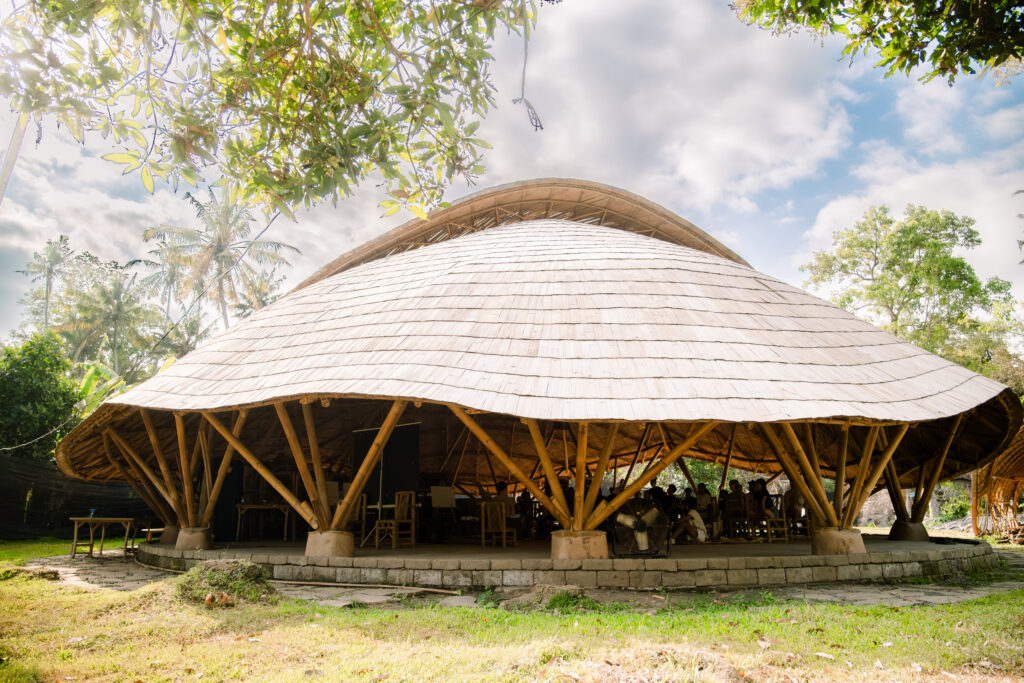
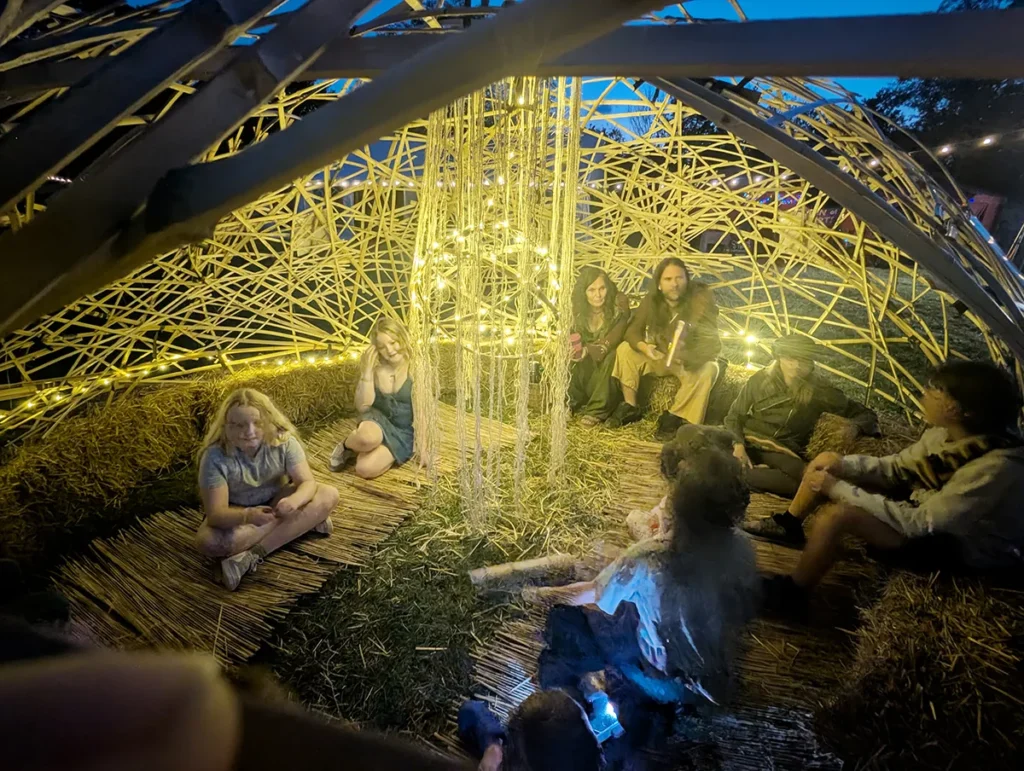
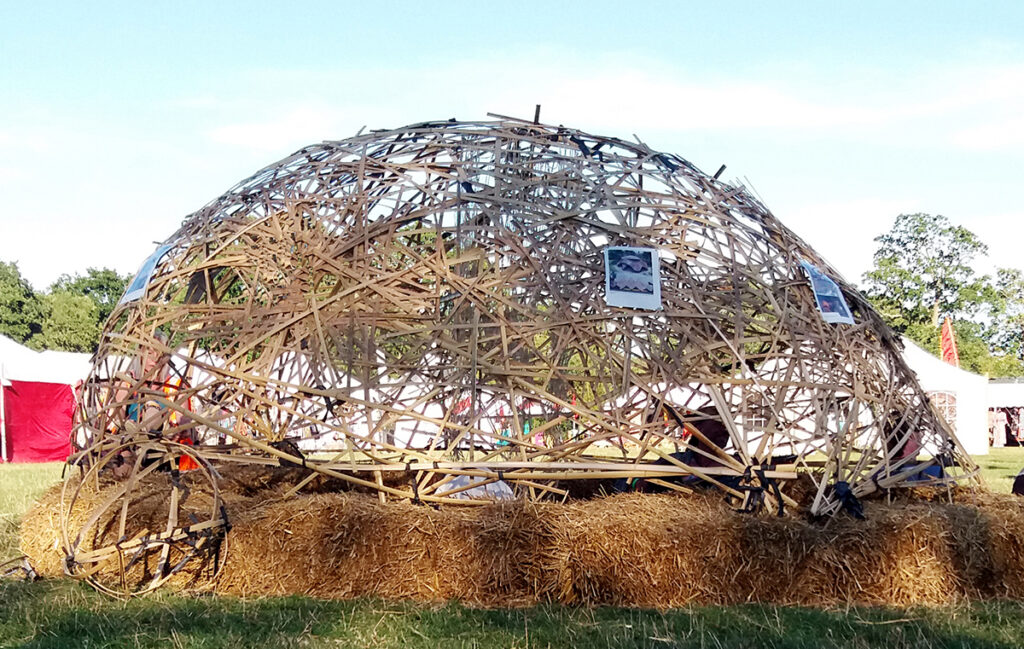
I built the Karma Map Dome at Tribal Earth Festival this August in southern England. The brief was simple: To create a bamboo chill-out space beside one of the main music tents. The outcome was a structure that tested form-finding, explored collaborative building, and introduced many festivalgoers to bamboo for the first time.
Related: Building a Community-Centered Pavilion in Bamboo with Augmented Reality (AR) Technology
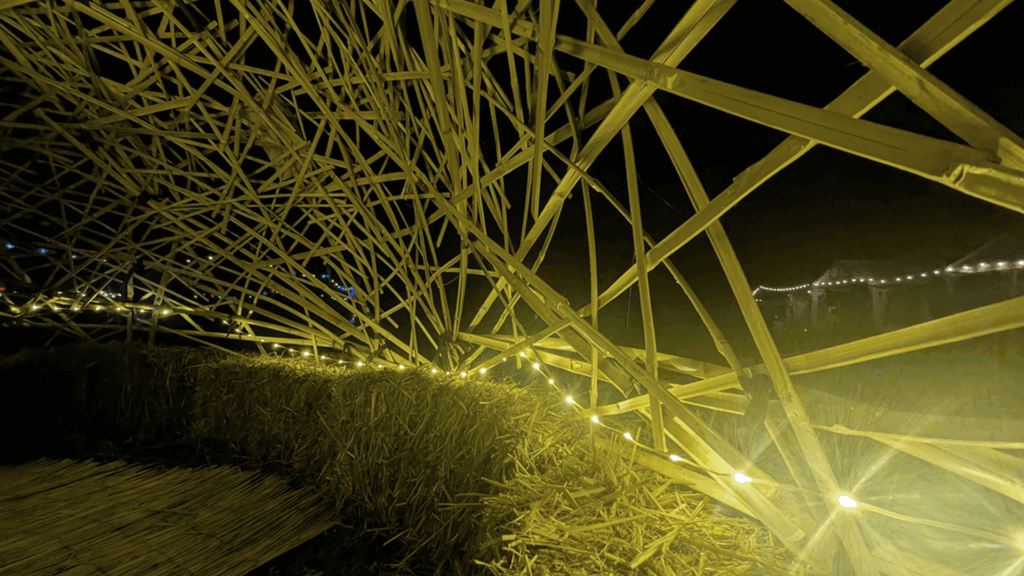
The starting point was the weave. Randomized bamboo splits resemble an astrological chart, lines intersecting into constellations. From that came the idea of the “Karma Map”: A space that suggested hidden patterns in our lives, even when we feel lost.
The overall form drew from the spiral of a conch shell. Conches are both ancient sea creatures and the material foundation of southern England’s chalk downs. Referencing the conch allowed the structure to look both upwards—to the stars—and downwards to the geology beneath our feet.
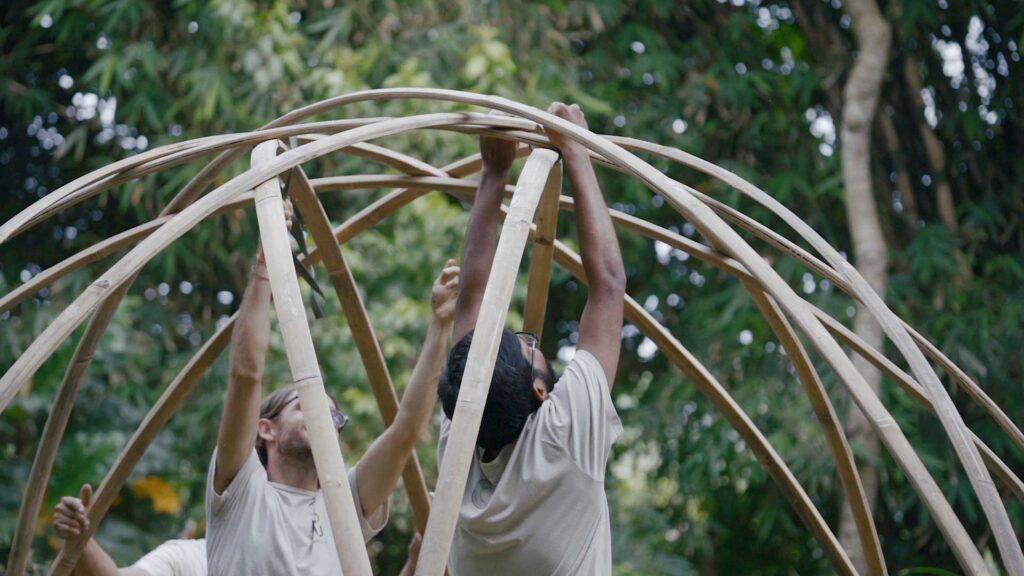
Equally important was participation. The dome wasn’t designed as a finished object but as a process. Visitors could weave splits into the frame, experiencing the material directly.
Related: It’s Time for Architects to Rediscover Natural Materials
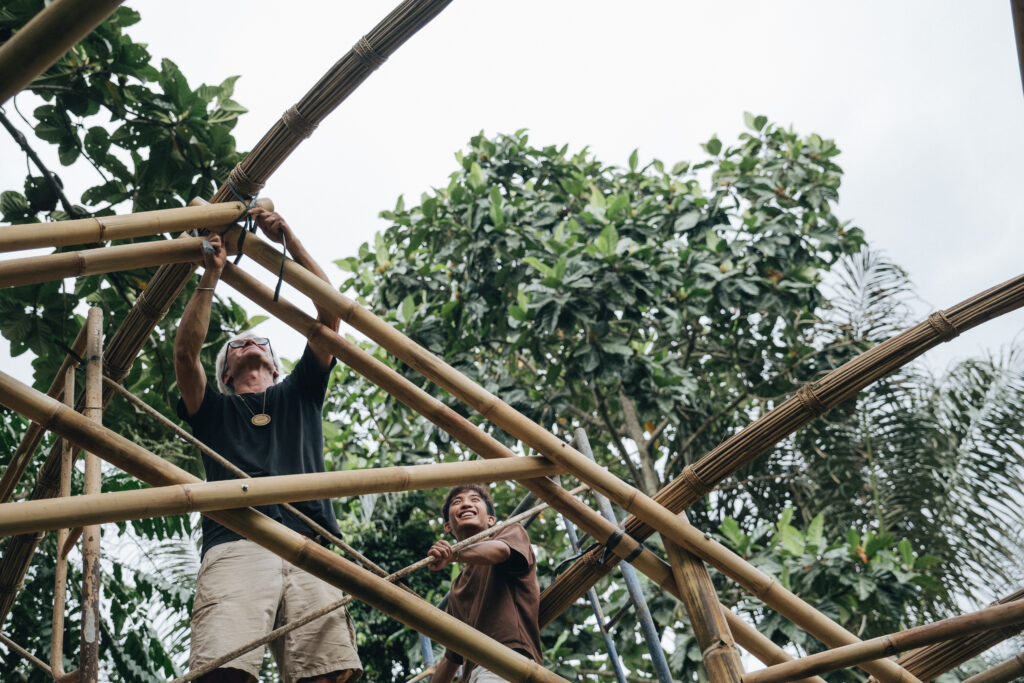
Bamboo was chosen for its lightness, strength, flexibility, and sustainability—but also because it allows experimentation at low cost. For the main structure, I used 2m x 3cm splits from bamboo fencing panels. Recycled bicycle inner tubes, sourced from a local volunteer bike workshop, bound these into 6m and 8m arches. The skin used finer 1m x 1cm splits, a combination inspired by Cave Urban’s gridshells in Australia.
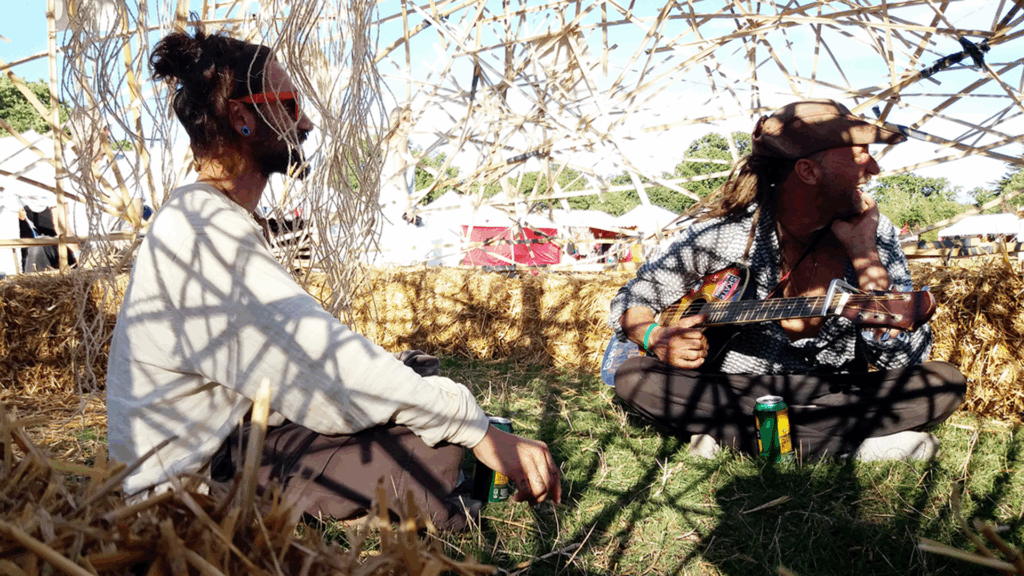
The whole dome sat on a spiral of hay bales supplied by a local farm. These provided informal seating and helped deaded acoustics on the interior.
The geometry came from two overlapping “leaf” forms. The larger leaf partially enclosed the smaller, creating a layered shell effect. This gave the entrance a distinctive, spiral-like quality—visitors were drawn in rather than simply stepping through.
The open weave was highly permeable, throwing shifting grids of light inside during the day and holding LEDs after dark.
Circular “windows,” inspired by northern Thai hill-tribe designs, were integrated into the weave. These were less visible once the structure densified—an adjustment for future iterations.
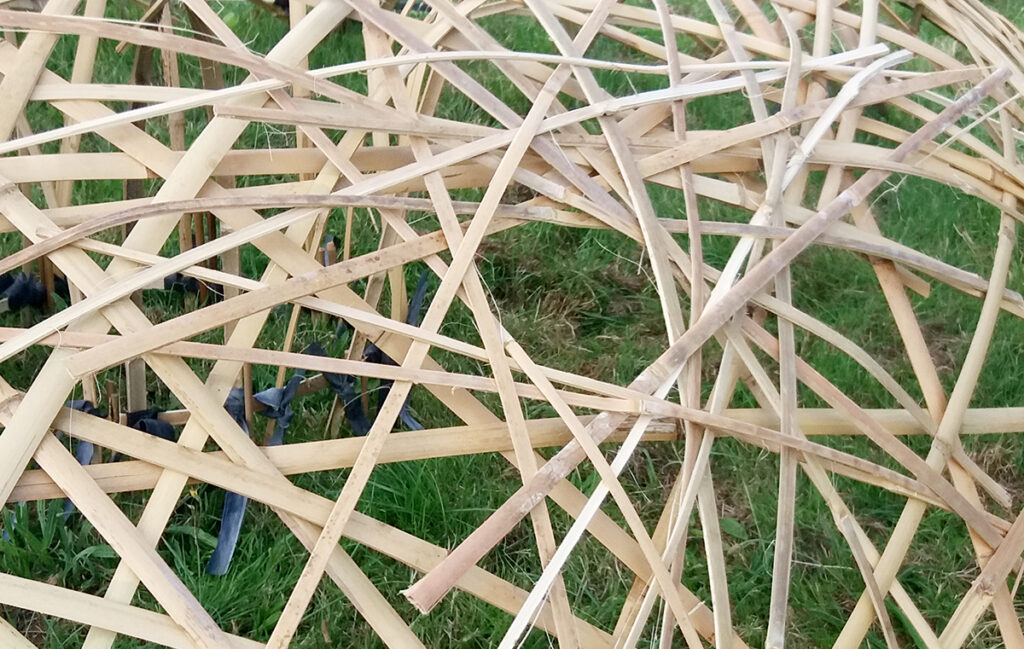
Lighting was the main technical challenge. I wanted to use programmable LEDs but without AC power, this was not feasible. Instead, I used solar DC string lights. At the centre, a suspended bamboo ring—wrapped with LEDs and string, after the style of Margherita Bertoli’s work in Italy.
To provide context, I added a small gallery of bamboo architecture to the exterior. Many people in the UK are unaware of the bamboo innovation happening in South-East Asia and South America, so this offered a direct link between the dome and the wider field.
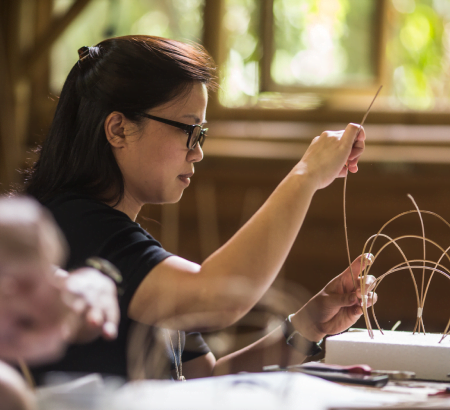
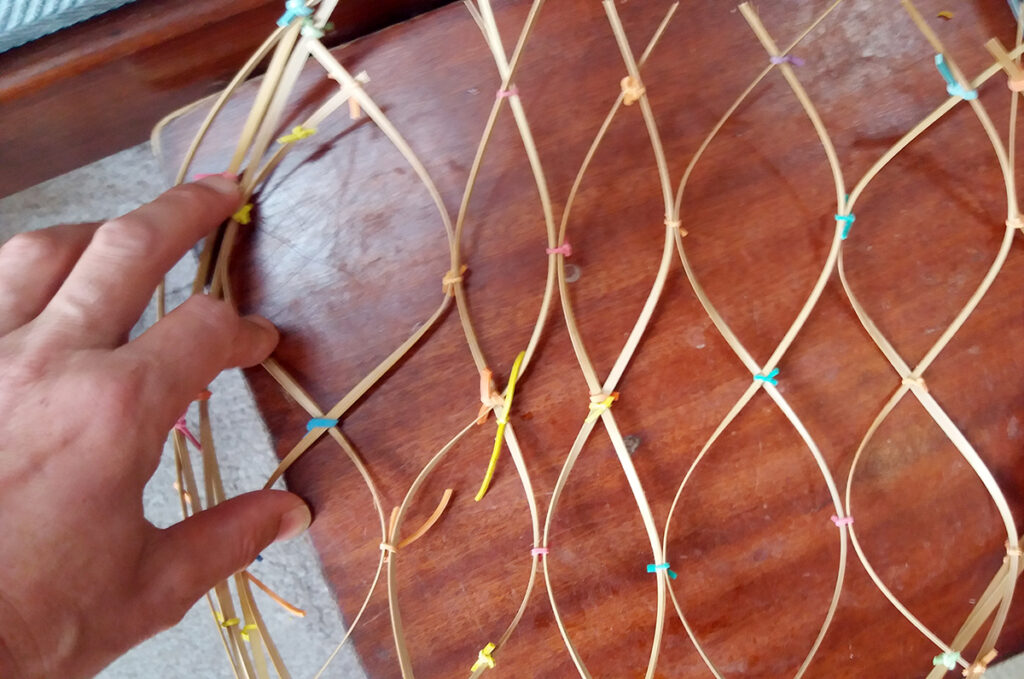
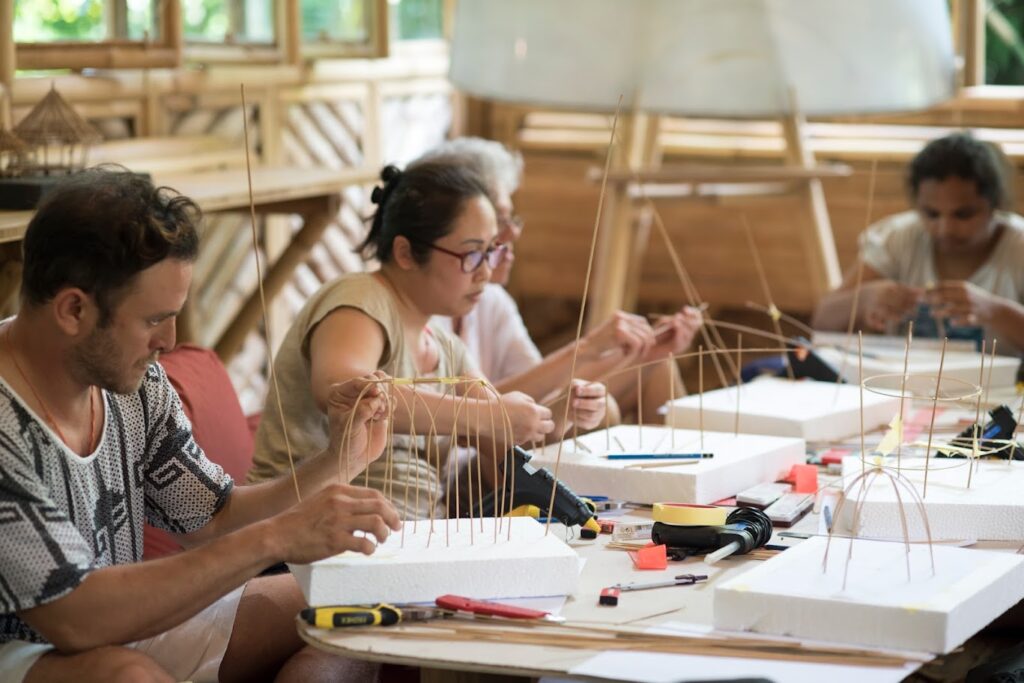
While prototyping, I developed a new assembly method: connecting bamboo splits into figure-8s with rubber bands, then linking them into a mesh. This allowed prefabrication of panels on the ground before lifting. The idea grew out of techniques I first encountered at BambooU in Bali.
At full scale, however, the 8m splits were unwieldy, twisting in the wind until stabilized with vertical arches. The geometry only resolved after considerable adjustment. Once standing, the weaving process became ideal for volunteers—simple, repetitive, and meditative. One participant summed it up: “I like this because I don’t have to think.”
The Karma Map Dome was an experiment in form-finding, construction method, and participation. It also served as a public demonstration of bamboo’s potential in a UK festival context.
The reception was positive: festival organisers invited us back, and visitors were surprised by the structural capacity of bamboo. For me, it was a reminder of what can be achieved when architectural experimentation meets a social setting. And while the technical lessons were valuable, the most rewarding outcome was seeing children step inside, captivated by the light and geometry. Their response was immediate and instinctive—proof that even a temporary structure can shift perception.
Want to try building with bamboo for yourself? Join us for an 11-Day Bamboo Build and Design Course!
Check out more of Will’s work HERE.
Join the 11-Day Bamboo Build and Design Course: hands-on building alongside experts, architects and makers from around the world. Explore the 11-Day Course
The 11-Day Build & Design Course
In collaboration with IBUKU
Immersed in the most beautiful and innovative bamboo environment. Meet the pioneers, the visionaries, the designers and builders who took this under-utilized material and transformed it into the most desired natural building material for bamboo structure design.
The Intro to Bamboo Engineering Online Course
Designed specially for structural engineers, this FREE online course has been created in collaboration with the Base Bahay Foundation, based in the Philippines.Join the course to learn how bamboo's innate properties make it a versatile building material, and how these properties can be maximized and applied in structural design.