Blending Structure and Natural Beauty with Casa Gavilán
By | December 2, 2025 | Student Work -
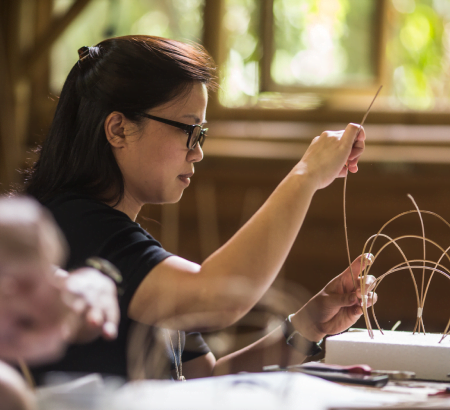
In May 2025, Natalia joined the Principles of Bamboo Design course. Through the course, she developed the project, Casa Gavilán. Read on to learn about her design process!
My motivation to join Bamboo U’s Principles of Bamboo Design course was to explore the artistic and intuitive dimensions of design that complement engineering: To understand how beauty, proportion, and intention can coexist with structural logic. Through the course, I learned to listen more deeply to the dialogue between site, nature, and human need, discovering how context can become a true design partner.
Perched where the mountains meet the sky, Casa Gavilán is a 200 m2 home that reveals a quiet dialogue between structure and nature shaped by the language of the Guarumo leaf (Cecropia Peltata).
Related: Designing a Multifunctional Bamboo Pavilion in Ubud
The project is located in the highlands of Pérez Zeledón, Costa Rica. Positioned at an elevation of 1,111 meters, the site lies between two valleys: The expansive Valle de El General, overlooking the Talamanca Range, and the smaller agricultural valley. The site offers wide views between 120°-150° and steady cross ventilation from west to east. A nearby stream introduces a constant acoustic presence. These conditions —light, wind, water, and slope— were treated as design parameters rather than constraints.
The project is conceived as a home-as-altar: A place where daily life and ceremony meet. The social core is a living room with a central hearth that opens visually to both valleys, framing gathering as a quiet ritual of warmth and belonging. The kitchen anchors the social sequence and evokes a familiar embrace, while the upper level offers retreat —a master bedroom and an office— oriented for contemplation and tuned to the sound of running water.
Materially, the house relies on Guadua angustifolia and Dendrocalamus asper for the primary structure, complemented by wood, natural stone, polished concrete, woven fibers, and glass to balance mass, texture, and transparency. The intended atmosphere is one of spaciousness, calm, introspection, and joy —heart, warmth, unity, and a quiet sense of wisdom— where the line between human intention and natural form gently dissolves.
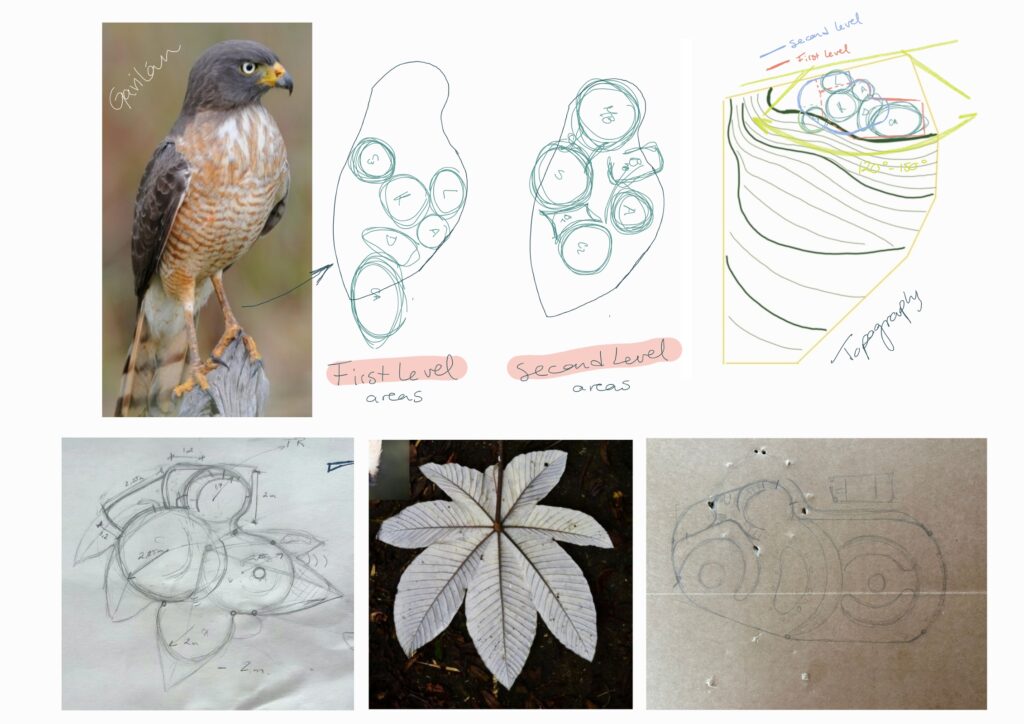
The development of Casa Gavilán from concept to model was a process of refinement and discovery. The initial idea emerged from a single-story functional diagram that organized spaces logically but lacked the organic essence sought for the project. Moving to a two-level scheme allowed for a more compact footprint and expressive roof composition inspired by the Guarumo leaf’s three-dimensional geometry.
Throughout this evolution, the challenge was to balance spacious roof spans with the absence of central supports, leading to a deeper exploration of structural redundancy, load distribution, and anchoring strategies that respected both form and function.
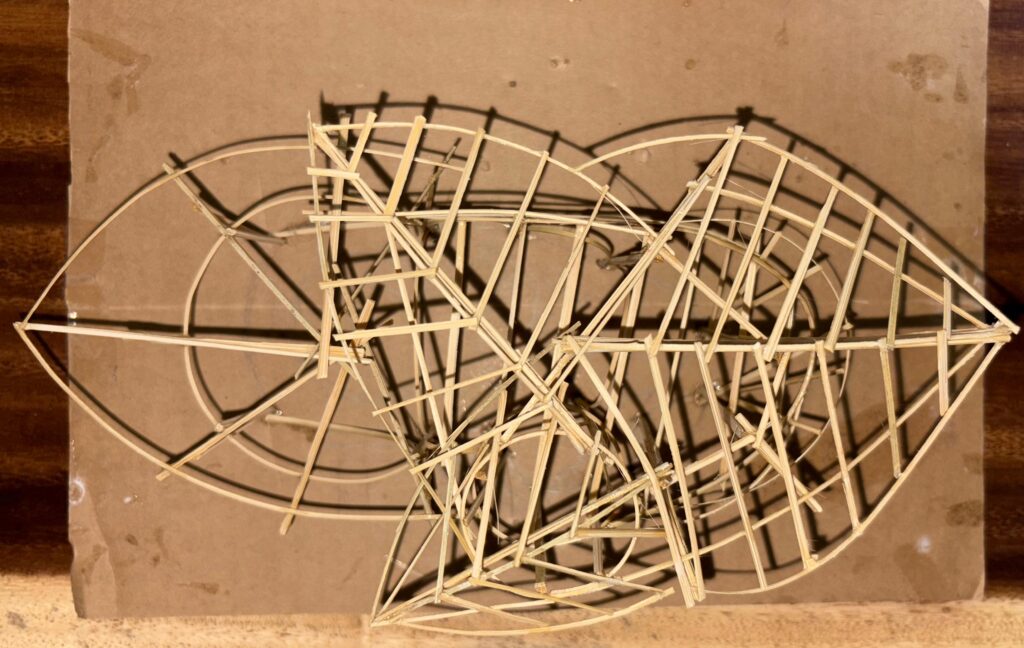
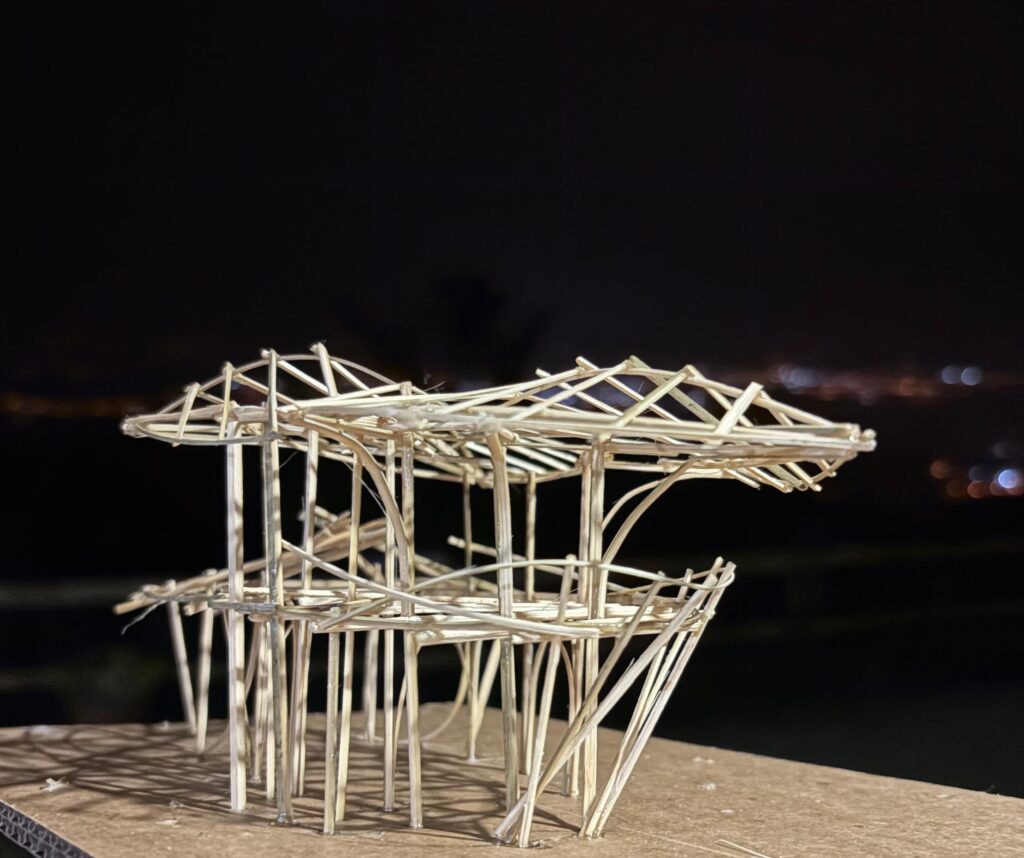
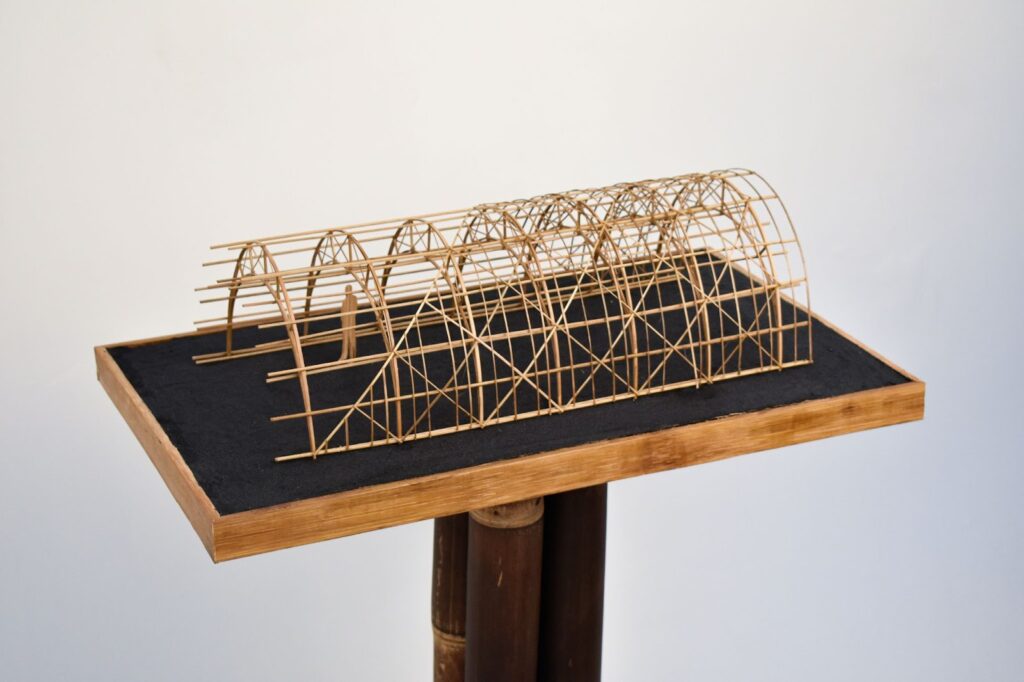
During the modeling phase, early large-scale attempts proved impractical for visualization purposes. This lead to an optimization of the final model being developed at a 1:100 scale that offered better control over proportions and the spatial relationship among components.
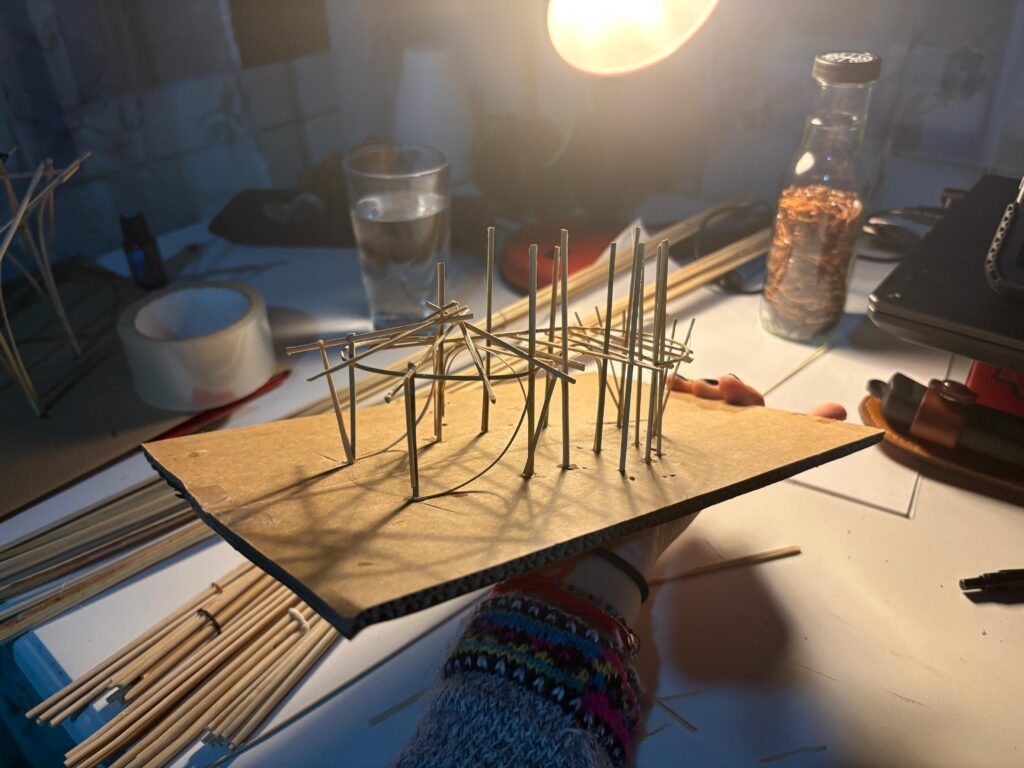
The final model was crafted using real bamboo pieces, which were cut, split, and shaped to represent different diameters, combined with cardboard and fast-drying adhesive. The hands-on process became an exercise in patience and precision, mirroring the pace of real construction. Working with natural bamboo revealed bending limits, bundle behavior, and the balance between structural strength and lightness.
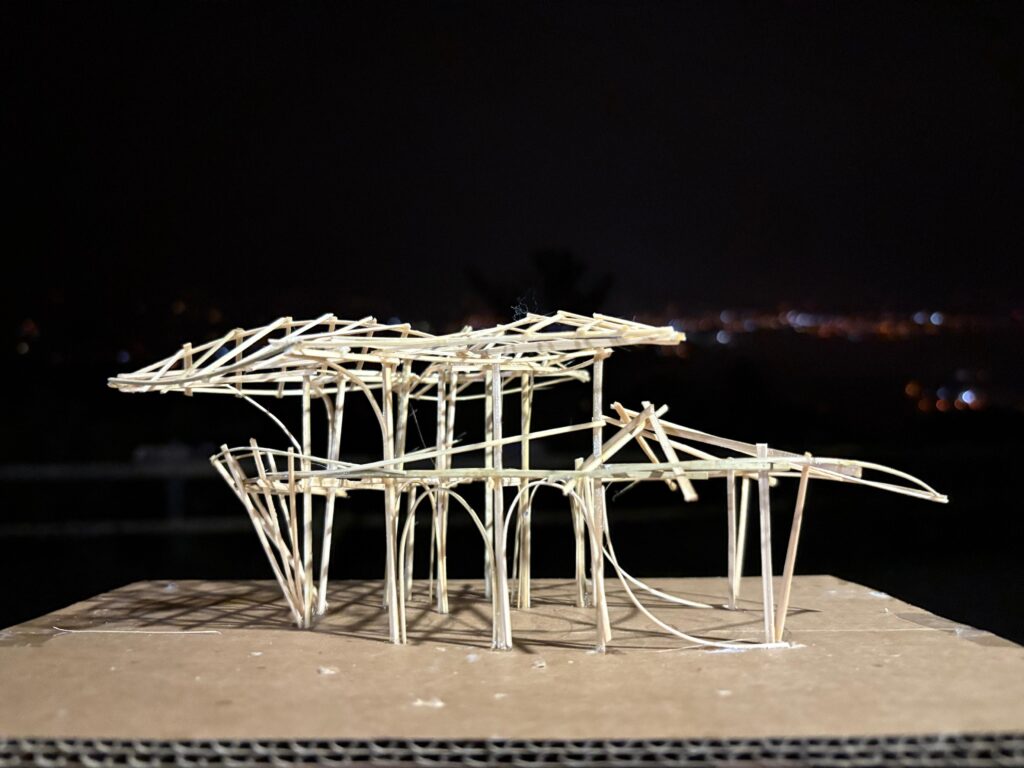
Structurally, the model incorporates reciprocal roof systems and curved trusses supported by peripheral frames rather than central columns, ensuring open interior spans and visual continuity. Diagonal and curved supports were introduced to strengthen roof overhangs without compromising the organic form. The entry tower features a reciprocal frame that anchors the roof structure and defines a robust point of convergence.
The course’s teachings on structural grids, column arrangements, and diagonal supports for balconies —inspired by Bambu Indah and other precedents— directly informed the final model. Although the model represents only the structural skeleton, it encapsulates the core logic of the building. It entails modular reciprocal systems preassembled on the ground and later lifted into place for practical on-site construction.
From a technical standpoint, the project anticipates Costa Rica’s strict seismic code, where column-to-foundation connections would be anchored using rebar dowels inserted within two bamboo nodes of each column, ensuring mechanical interlock. Beam-column joints are proposed as fish-mouth connections to guarantee continuity of load paths. Beyond technique, the experience of building the model revealed how creativity and engineering converge in the language of bamboo. It demonstrated that structure is not merely a system of forces but a form of expression—one that listens to material behavior, site conditions, and the rhythm of human intention.
Related: Handcrafting a Bamboo Lamp Inspired by the Magnolia Flower
The Bamboo U course offered more than technical insight —it provided a framework for listening to material, site, and intention as one continuous dialogue. Learning to observe the relationship between landscape, human need, and structural response became one of the most meaningful takeaways. The emphasis on understanding site conditions, proportion, and natural geometry transformed the way Casa Gavilán evolved, from a conceptual idea into a structure that truly belongs to its mountain setting.
Among the modules, those focused on structural systems and natural form-making were especially impactful. They encouraged experimentation with redundancy, reciprocity, and curvature —concepts that directly shaped the project’s roof system and spatial rhythm. Beyond methods and techniques, the course reaffirmed a core belief: that designing with bamboo is not simply about construction, but about cultivating sensitivity, patience, and respect for living materials. Casa Gavilán is proposed as a reflection of that philosophy —an invitation to keep learning from the quiet intelligence of nature.
Want to bring your bamboo dreams to life? Join one of our design courses to transform your ideas from concepts to reality!
Click HERE to enroll in one of our courses!
Join the 11-Day Bamboo Build and Design Course: hands-on building alongside experts, architects and makers from around the world. Explore the 11-Day Course


The 11-Day Build & Design Course
In collaboration with IBUKU
Immersed in the most beautiful and innovative bamboo environment. Meet the pioneers, the visionaries, the designers and builders who took this under-utilized material and transformed it into the most desired natural building material for bamboo structure design.
The Intro to Bamboo Engineering Online Course
Designed specially for structural engineers, this FREE online course has been created in collaboration with the Base Bahay Foundation, based in the Philippines.Join the course to learn how bamboo's innate properties make it a versatile building material, and how these properties can be maximized and applied in structural design.