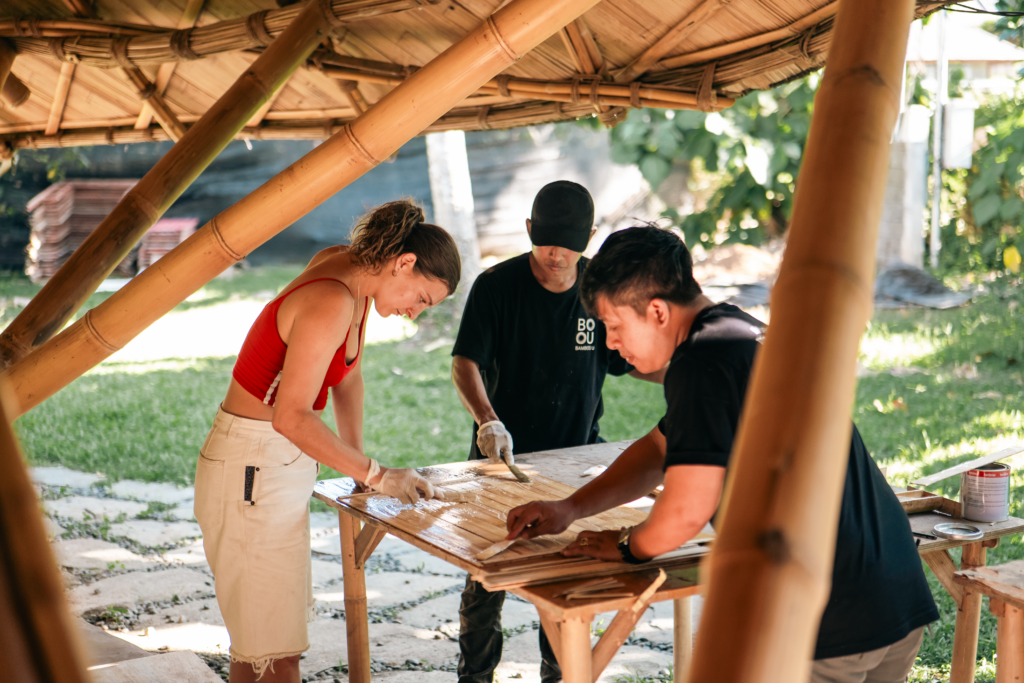
I always found that experimentation is the best way to design. As I came with some basic timber carpentry experience to the 11-Day Bamboo Build and Design Course, it made sense to me to uplevel my skills by learning how to laminate. The process of lamination shines a whole new light on the possibilities of designing with bamboo. It allows for clean and crisp finishes including with all kinds of shapes. Structures come together through layers, pressure, glue and time.
My time in the carpentry station gave me the opportunity to really feel the material and experiment with it. Working with bamboo meant being bold, creative and trusting in the process. There is just something about using your hands and connecting with a material to really understand it.
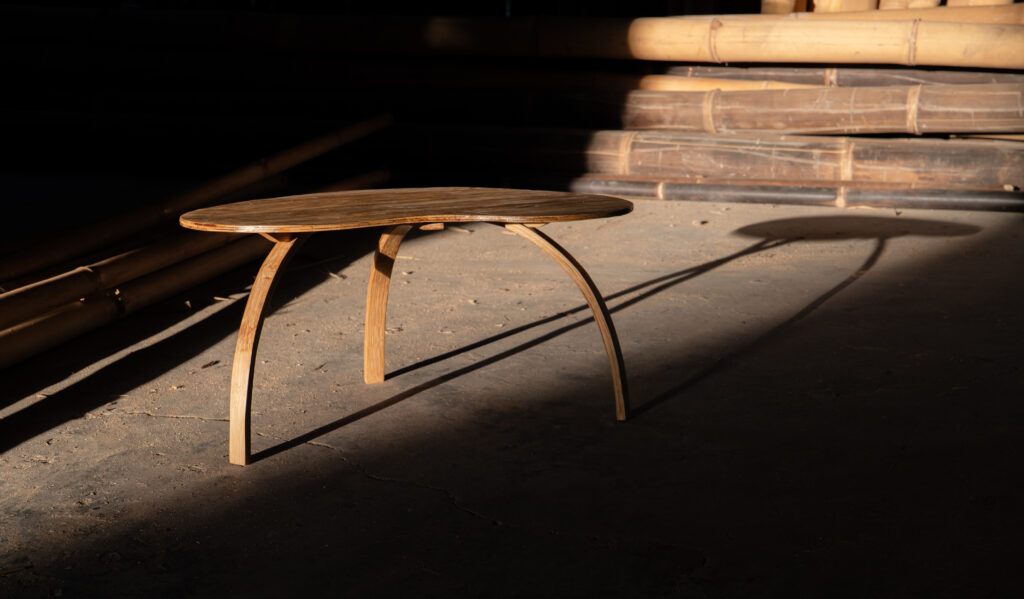
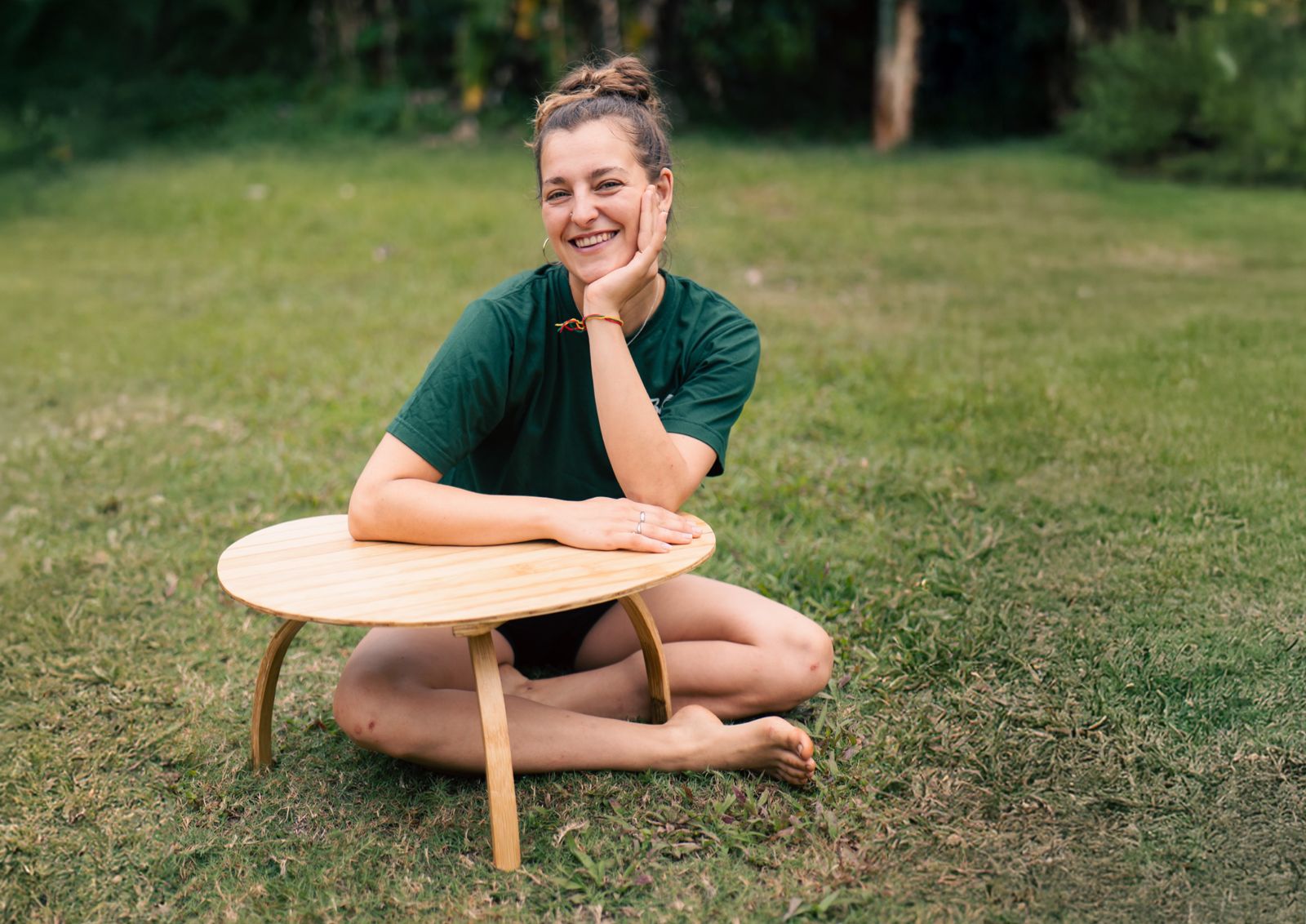
Given the chance to design and craft my own ideas in the carpentry station, I wanted to create something meaningful to use at work over the coming months. After spending the first couple of weeks in the office, I quickly realized that I was missing the ability to work while standing – that’s where the idea of “The Bean” was born.
Related: Answering The Top 4 Questions We Get About Bamboo
Designing the Desk
Inspired from the organic forms of bamboo buildings and furniture I’ve been seeing around Bali, I was naturally drawn to designing a piece that invites natural shapes.
To start the process, I sketched out my first ideas of how the form of the table could best serve me. I wanted the table to wrap around me, giving my arm more space to rest and allowing me to use the mouse while still standing close to the table.
I personally love minimalistic furniture design so I wanted each piece to be designed intentionally, with every part being both functional and beautiful. I designed my piece with care and no Schnickschnack, which is German for something that doesn’t add any value.
Crafting the Desk
I loved the entire design and build process. From discussing details with Moko, the station’s head carpenter, and his team, to adapting along the way, every stage of the project was a learning experience. I picked up new techniques and skills while mastering the use of new tools. The bamboo I chose to use for my project was Dendrocalamus Asper. I started by creating the laminated three-layered bamboo panel for the table top. Once dried, I cut it into shape with a jigsaw.
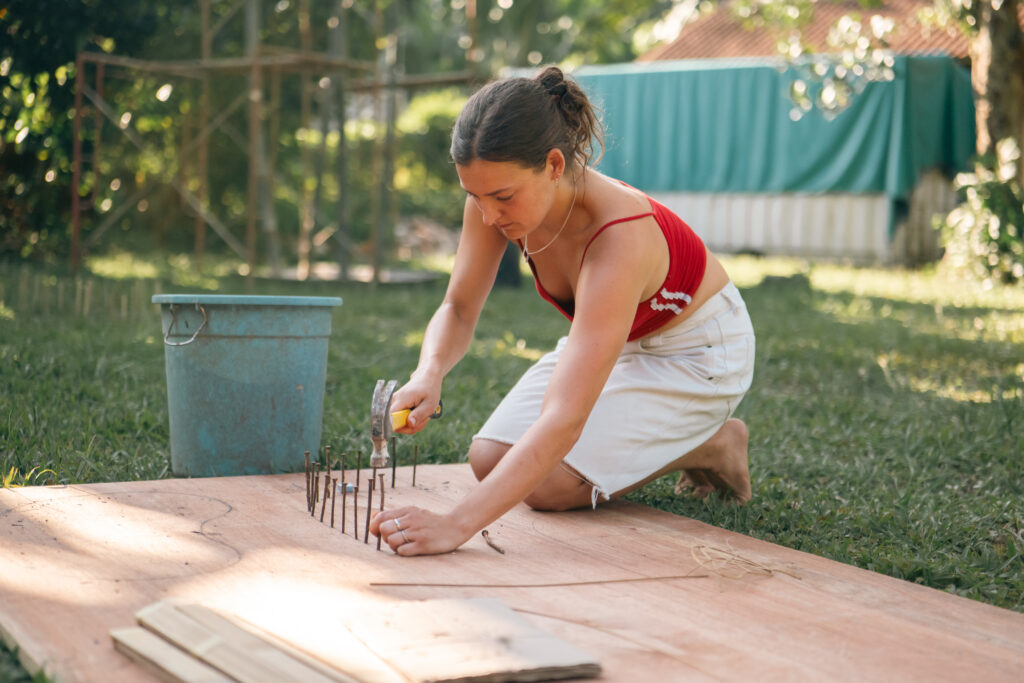
To bend and form the legs the way I wanted them shaped, I created templates for the lamination process of each leg. These helped me to hold the legs in place while the epoxy mixture dried. It was really interesting seeing how seemingly simple tools, such as old wooden planks used as a base to nail into, could help to build a table like that. I also got a feel for using the mutik, Indonesian for knife, for quick fixes.
Related: The 3 Key Design Features of Bamboo Split Beams
How to Use a Template for Laminating Curved Forms
To craft the legs for my desk, I first drew their shape onto a piece of wood. Since the design had two open ends rather than forming a full circle, I extended the lines by about five centimeters on each side to leave room for adjustments after the epoxy had dried. Thick nails were placed along these lines and I started the laminating process. I took the first precut split, applied an epoxy mixture with a brush and laid the second split onto it. Then, I pressed the two pieces into the template and secured them with a couple of nails before continuing the process until all five splits were in place.
I noticed that, especially in curved sections, the splits tended to push away from each other, so I used as many clamps as possible to avoid gaps.
Even though I used many clamps to hold the splits together I ended up with multiple air pockets between the splits both in the legs and the table top. I sanded everything to remove all the extra epoxy and filled the air pockets with an epoxy, bamboo and sawdust mixture. This step was a simple solution to an aesthetic issue I got taught by the carpenters which made the appearance and feeling of the furniture much smoother.
Related: A Lamp Inspired by the Intersection of Traditional Craftsmanship and Power Tools
I spent about two and a half days building my standing desk, plus a few extra hours for sanding, detailing and finishing. Looking back, the desk itself is almost standing in the shadow of what I learned through the process.
Moko repeatedly said to me “There’s always a solution”, a mindset that strongly resonates with me. Whether a split cracked, a template shifted or something didn’t go as planned, he and his team always had at least three ideas up their sleeves. Through being hands-on in this project I gained a much deeper understanding of the material and its possibilities.
Before coming to Bamboo U, I had already fallen in love with bamboo architecture, its organic shapes, and flowing structures. The way buildings fit so naturally into their environment, not feeling like they take from it but instead give to the surrounding area.
What I didn’t yet understand was how these beautiful forms were actually made. I didn’t know how to laminate splits, how to bend bamboo, or how to transform round bamboo poles into furniture. Joining Bamboo U and the 11-Day Bamboo Build and Design Course in Bali gave me the opportunity to learn and develop a new skill set firsthand.
My biggest takeaway is that building with bamboo requires a different mindset and a lot of flexibility in the process. Building “The Bean” taught me that bamboo is not simply an alternative to wood. It’s a material with its own logic, character and possibilities.
Want to craft your own bamboo project? Join us for our next 11-Day Bamboo Build and Design Course by tapping this link!
Join the 11-Day Bamboo Build and Design Course: hands-on building alongside experts, architects and makers from around the world. Explore the 11-Day Course


The 11-Day Build & Design Course
In collaboration with IBUKU
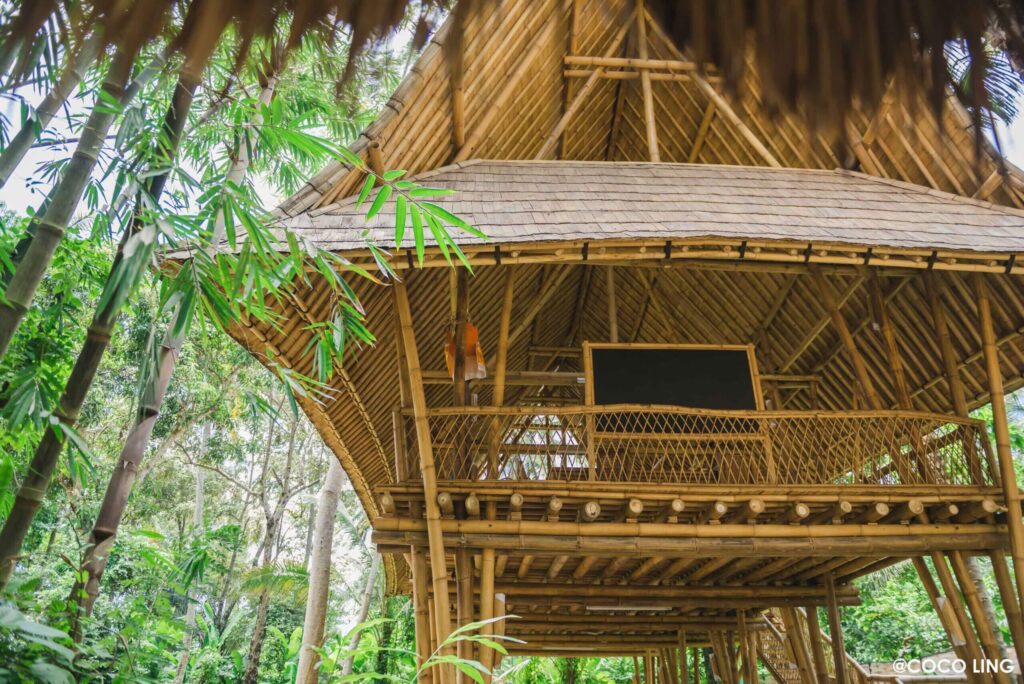
Immersed in the most beautiful and innovative bamboo environment. Meet the pioneers, the visionaries, the designers and builders who took this under-utilized material and transformed it into the most desired natural building material for bamboo structure design.
The Intro to Bamboo Engineering Online Course
Designed specially for structural engineers, this FREE online course has been created in collaboration with the Base Bahay Foundation, based in the Philippines.Join the course to learn how bamboo's innate properties make it a versatile building material, and how these properties can be maximized and applied in structural design.