Bamboo Engineering – What you Need to Know
By | April 14, 2026 | Engineering -

Bamboo doesn’t behave like other building materials, and that’s part of what makes it so exciting to work with. Its hollow form, nodes, tapering shape, and directional fibers give it unique structural properties. Those who develop a deep understanding of the characteristics of bamboo are able to push the boundaries and create exciting new ways to build with bamboo.
Part of what makes bamboo such an impressive material for engineering is its nature as a composite. Similar to reinforced concrete, where steel and cement combine to handle different structural loads, bamboo’s fibrous vascular bundles carry tensile forces. These are embedded in parenchyma cells that offer support and flexibility. These fibers run in a single, parallel direction along the length of the culm, giving bamboo its incredible tensile strength. But this unidirectional alignment also requires careful attention when designing joinery, as forces applied perpendicular to the fibers are less supported.

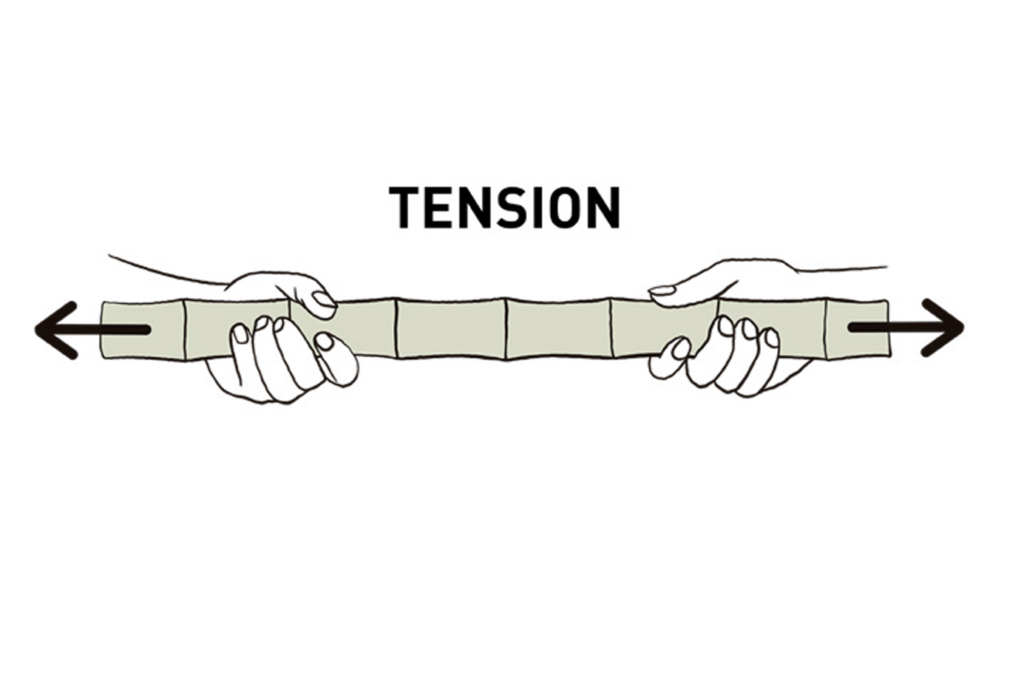
Tension: A stress or force that pulls at the two opposite ends along the length of an object or material.
Tensile strength is one of bamboo’s most impressive properties. When in tension, bamboo’s strength-to-weight ratio is better than that of steel. This does not mean that bamboo is as strong as steel, only that it can perform better than steel in tension if the same weight of material is used. Most usual joints tend to fail before the bamboo does under tensile stress. So it is particularly important to use joinery methods that can effectively transmit tensile forces between bamboo members.
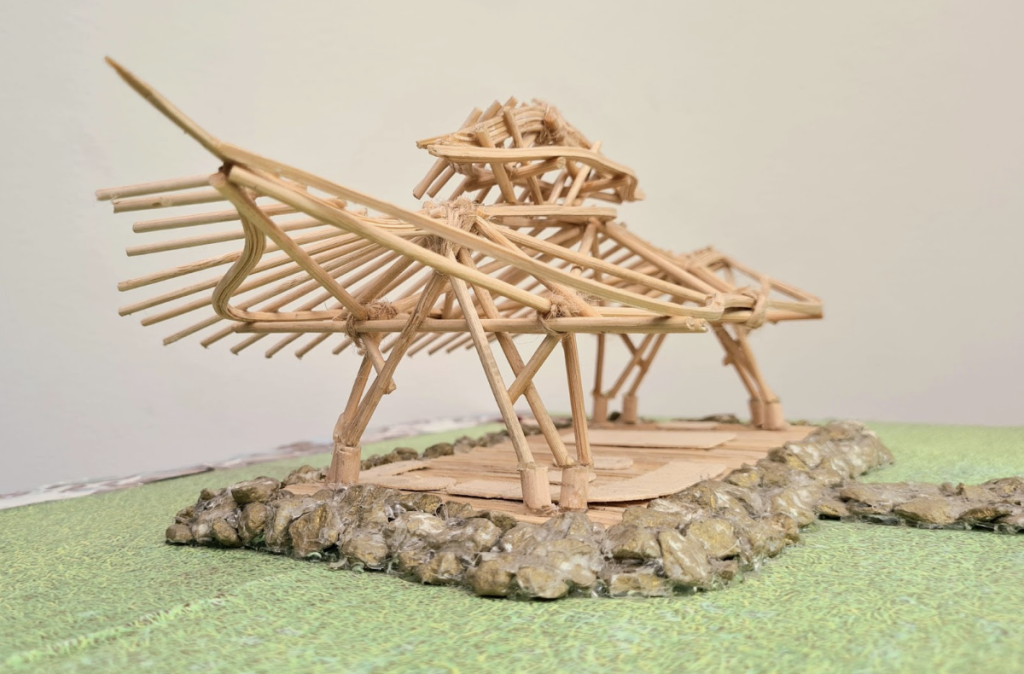
Designed in collaboration with Jörg Stamm, Bamboo Hall is a structure that works entirely in tension. Built during the 11-Day Bamboo Build and Design Course in August 2019, the hall uses the tensile strength of bamboo to achieve its wide span and weightless appearance. The design consists of seven hyperbolic paraboloids, each constructed on the ground from a grid of round bamboo poles. These are twisted into the hyperbolic paraboloid shape before being lifted into position, resting on nine foundation points. Once raised and connected, the hypars form a continuous, self-supporting shell.

Rather than relying on internal columns, the structure’s strength comes from the tensile forces distributed throughout it. Flattened bamboo, known as pelupuh in Bali, is layered in two opposing directions across the top of each hypar. This helps to lock the geometry in place. Bamboo Hall demonstrates how the tensile strength of bamboo can be harnessed to create elegant, light, long-spanning forms using minimal material.
Related: How to Build with Bamboo – Structural Systems
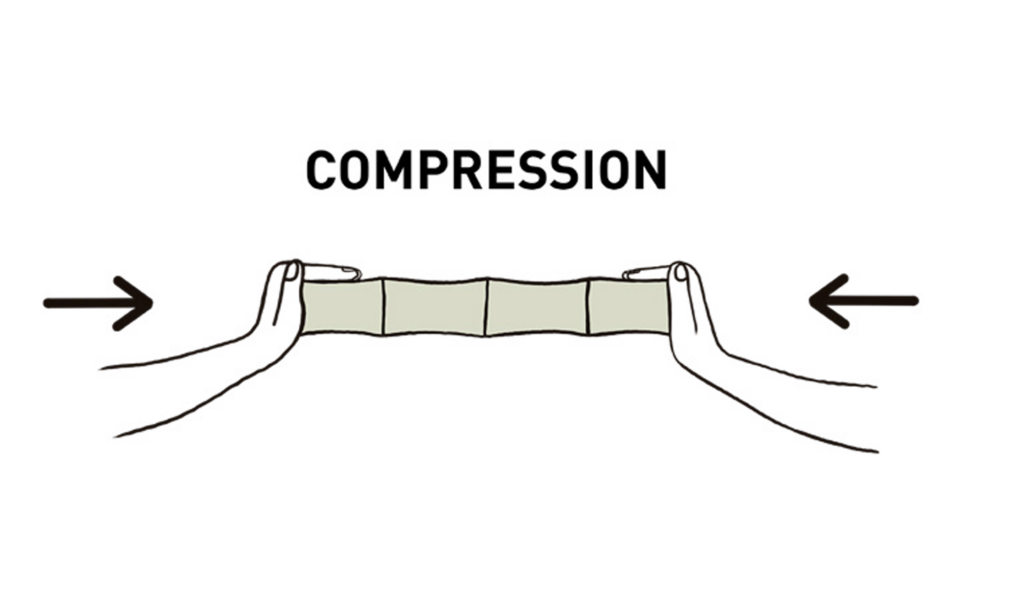
Compression: A stress or force that pushes an object or material to crush or compact it.
The most important thing to understand about the way bamboo acts in compression is that its compressive strength differs along the length of the pole compared to the way it acts along the cross section of the pole.
Along the length of the pole (the direction in which the fibers run), bamboo has a very high compressive strength, similar to that of concrete. Bamboo’s excellent compressive strength lengthways makes it well suited for columns and vertical supports. This is only as long as the forces follow the direction of the grain.
However, due to its round, hollow profile, bamboo does not perform well when compressive forces are applied against the short cross section of the pole. This is when the force is applied perpendicular to the direction of the fibers.
For example, in a post-and-beam bamboo structure, the vertical poles carry compressive loads from the roof and upper levels down to the ground. Because these loads act along the length of the pole, the excellent longitudinal compressive strength of bamboo makes it ideal for this purpose. However, at the points where horizontal beams connect to the vertical poles, care must be taken to avoid applying too much force, as bamboo is much weaker in that direction. Proper engineering of joinery, bracing, and pole selection are critical to prevent crushing or buckling of the bamboo. By working with the directional strength of bamboo, structures can be both strong and durable.
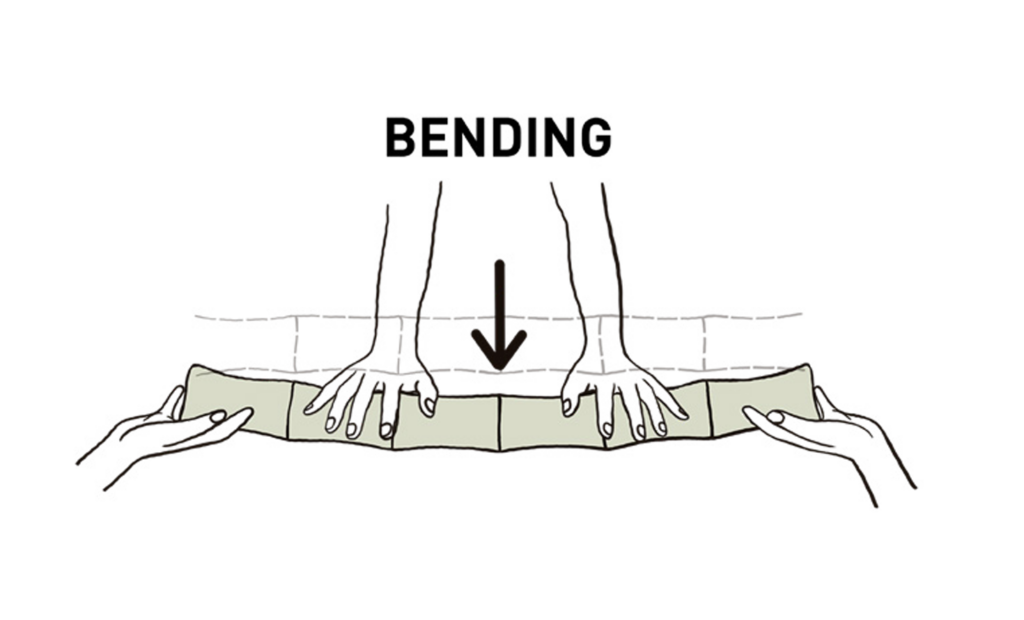
Bending: A stress or force acting perpendicular to an object’s length, causing the object or material to deform or bend.

Bamboo’s ability to bend without breaking is one of its most useful structural traits. How it behaves under bending depends on both scale and form. Round poles are stiffer and resist bending, while splits offer much greater flexibility and are easier to curve. This makes poles ideal for compressive elements, while splits are better suited to components in tension or bending, such as arches or domes.
When engineering with bent bamboo, it’s also important to design joinery that allows some movement. Rigid connections – such as fixing a pole directly into concrete – can lead to cracking over time as stress builds up in localized areas. Joints such as fish-mouths, angle joints, bamboo pins, or bolts offer the flexibility needed to absorb these forces without failure.

The Pool Pods on the Bamboo U campus provide a clear example of bamboo’s bending capacity. To create the pods, bamboo splits were woven into organic forms, making use of bamboo’s ability to bend well without breaking. Because splits handle bending so well, they allow for the creation of more dramatic forms that would be difficult to achieve with full poles.
Related: The Building of Bamboo U Hangout Pods with Arquitectura Mixta
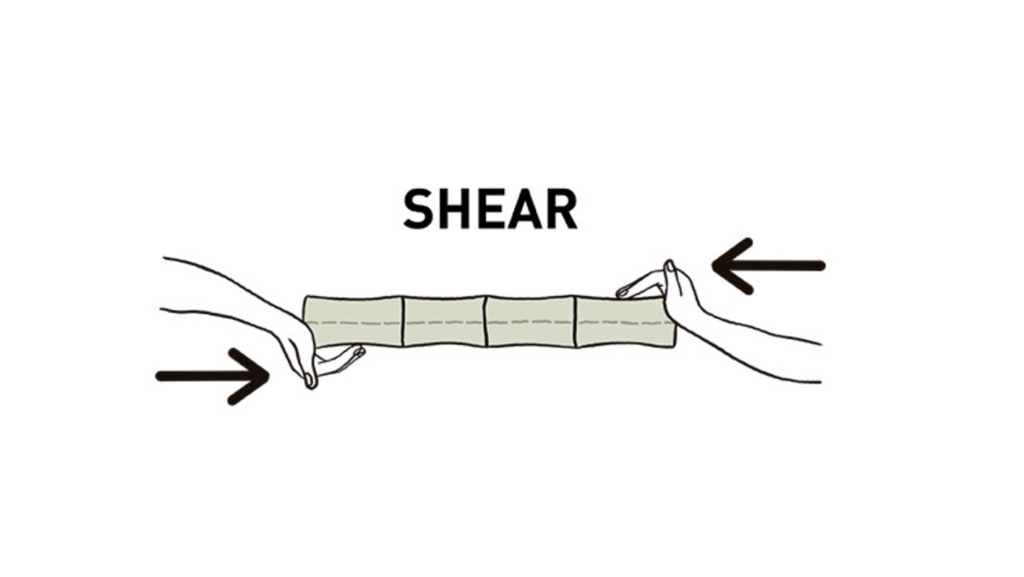
Shear: A stress or force that occurs when two parallel forces push against each other along or near the same plane of an object or material.
Since the structure of bamboo is made up of nodes and internodes, bamboo resists shear forces perpendicular to the length of the pole quite well. However, bamboo does not react as well to shear forces applied parallel to the pole and tends to split along its fibers. This is often where a bamboo pole will fail, with shear forces (particularly in parallel) considered to be bamboo’s weakness.

As a result, shear strength becomes a critical consideration in bamboo joinery. This is because screws and bolts transfer concentrated loads to a small area of the bamboo. This can cause the fibers to split and lead to shear failure. In bolted joints, filling the internodes with mortar can help reinforce the area, improving the connection’s capacity to resist both shear and compressive forces.
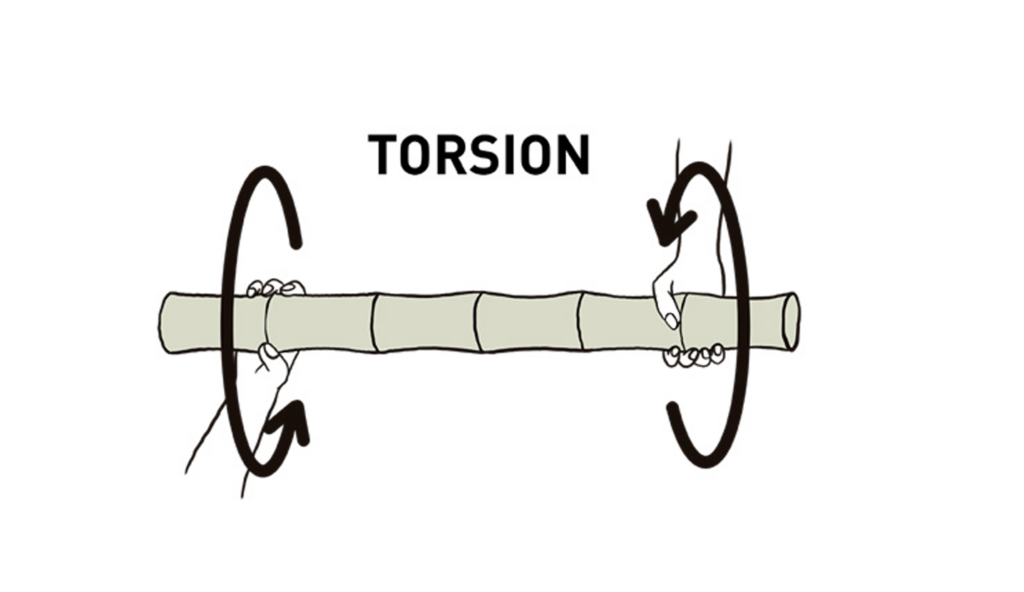
Torsion: A twisting force that is applied to an object or material along its axis.
There have been very few studies investigating the torsional properties of bamboo, so there is not sufficient certainty about its properties. Therefore, if the structural members can withstand the other forces, it can be assumed that the torsion requirements will be met.
By working with the material’s natural strengths for engineering purposes – including its tensile capacity, compressive resistance, flexibility and shear behavior – we can create structures that are efficient, appropriate, and well-suited to bamboo’s unique characteristics.
Want to dive into structural engineering for bamboo?
Join our FREE Intro to Bamboo Engineering Course to understand the basics of structural design!
Start with bamboo engineering, free.
An introduction to bamboo engineering, created with Base Bahay Foundation. Free, online, start today.
Start the Free CourseSee all online courses








The 11-Day Build & Design Course
In collaboration with IBUKU
Immersed in the most beautiful and innovative bamboo environment. Meet the pioneers, the visionaries, the designers and builders who took this under-utilized material and transformed it into the most desired natural building material for bamboo structure design.

The Intro to Bamboo Engineering Online Course
Designed specially for structural engineers, this FREE online course has been created in collaboration with the Base Bahay Foundation, based in the Philippines.Join the course to learn how bamboo's innate properties make it a versatile building material, and how these properties can be maximized and applied in structural design.